Author: Emiel Bakker, Product Specialist, Nootropics Depot
March 26, 2026

Author: Emiel Bakker, Product Specialist, Nootropics Depot
March 26, 2026
InfiniFiber reimagines fiber supplementation by treating fiber as a sophisticated prebiotic and synbiotic tool for gut, metabolic, and brain health, rather than a simple bulking agent.
For those of you who’ve been around for a long time, you’ll know that when we first started out, we mostly specialized in highly novel nootropics. Over the years, we transitioned more and more into finding this novelty in botanicals, fungi and seaweeds. Throughout this process, we also started focusing more on the “basics”, such as B-vitamins, Vitamin D and even branching out into electrolytes, via our recent Infinilyte release. What we started to realise is that these “basics” are only perceived as being basic, because they are often formulated in the simplest way possible. We first realised that this was the case with our B-Complex, Infini-B. After a ton of R&D work, we created a formulation that was very balanced, energy boosting, and mood boosting. An effects profile that really blew us away when we nailed it, and once it was released, a lot of you reported being very impressed by the effects profile too. This made us think, what other basics could be improved upon?
Since we are based in Phoenix, Arizona, one of the hottest and driest cities in the U.S., we definitely were no strangers to electrolytes, so the first thing that came to mind was how can we formulate the ultimate electrolyte? Electrolytes seem very simple at first glance, and most people just think it’s about sodium and potassium. This thinking is clearly very pervasive, because most electrolytes on the market only contain sodium and potassium. However, the more we looked into mineral losses via sweat, it appeared that for ideal performance, it all gets a lot more complex. We spent close to a year doing R&D work on our electrolyte formulation, and when we nailed it, all of us on the beta-testing team were amazed at how good it made us feel. Once we released the formulation, which is now known as Infinilyte, reports started flooding in from other users, which corroborated what we experienced, it makes you feel great! This really started opening our minds to the possibility of tweaking the “basics” of the supplement world, in a way where we can produce very efficacious products that have unique effect signatures!
After the electrolyte, we were looking for a new challenge in the realm of “basic supplements”, and one category really stood out, fiber supplements! Fiber is arguably one of the more basic supplements around, and almost everyone seems to have at one point tried out a fiber supplement like metamucil. It's also very much associated with elderly people it seems, which have made fiber supplements seem really unsexy for younger supplement enthusiasts. However, something positive has been happening the last few years, and that’s our collective awareness of our gut microbiome increasing, and fiber supplements getting a cool new name; ‘prebiotics’. All of a sudden, there is a lot more demand for fiber supplements, and more and more interesting fiber supplements are coming out that aren’t just Psylium husk. This made us very curious how far we could push the concept of a fiber supplement, and we believe we have very much pushed fiber supplementation to the cutting edge, with Infinifiber!
The primary approach we took to making the most interesting and efficacious fiber supplement we could imagine, was to treat it more as a prebiotic, rather than just a fiber supplement. There are some major distinctions to be made with fiber. Not all fiber acts the same, some are soluble, whereas others are insoluble. Some are fermentable by gut microflora, whereas others aren’t. So for example, if we look at the alpha-cellulose in Infinifiber, this is an entirely insoluble fiber that is also very resistant to fermentation. This allows it to act as a bulking agent for our stool, helping to pull water into our stool and give it good structure. This is very important for the smooth passage of stool through our highly sensitive GI system. This is probably the type of fiber most people imagine when thinking about fiber. Something that simply makes you poop a little bit better. That angle is certainly there with Infinifiber, but it goes A LOT deeper, and this is where we had a very interesting time with formulating!
We’ve already briefly covered insoluble and non-fermentable fibers, so now let’s move on to where it gets a lot more interesting, the fermentable fibers! The fermentable fibers are what are now commonly referred to as prebiotics. This is because they provide a source of energy for the microbes in our gut. An easy way to think about it, is that when we eat food, the majority of it can be broken down into readily absorbable nutrition by the complex array of digestive enzymes that are present in our gut. However, the fermentable fibers, and resistant starches in food, cannot be broken down by our gut digestive enzymes. Due to this, they do not have nutritional content for us. However, the bacteria that make up our microbiome contain highly specialized sets of enzyme systems that allow them to ferment these fermentable fibers and resistant starches. This then provides those bacteria with energy. With this energy, they can multiply, and become more abundant, thereby increasing the overall strength of our gut microbiome. Another important concept to consider with the fermentable fibers and resistant starches, is that when they undergo fermentation, they end up producing unique metabolites. Specifically, they end up producing a class of compounds collectively referred to as the Short Chain Fatty Acids (SCFA). Amongst these SCFA, the three most abundantly produced ones in humans are acetate, propionate and butyrate.
These SCFA are extremely important to human health, and the more we learn about the microbiome, the more we come to realise that the SCFAs are the primary link between our gut and the rest of our body, including our brains! Undoubtedly, you’ve heard about the gut-brain axis by now, and the question to ask here is, how are the gut and brain communicating with each other? Well, that answer can be partially found within the SCFAs!
The SCFAs, after being produced by microbial fermentation of fibers and resistant starches, then get taken up into circulation, and easily pass through the Blood Brain Barrier (BBB). Once in the brain, they can get to work upregulating critical neurotransmitter producing enzymes. For example, propionate increases the activity of tryptophan hydroxylase, whilst butyrate increases the activity of tyrosine hydroxylase. These are the two rate limiting enzymes responsible for both serotonin and dopamine (and by extension, norepinephrine) synthesis. Thus, by increasing propionate and butyrate levels via the consumption of fermentable fiber, we can effectively increase the synthesis of key neurotransmitters in the brain. It is thus no wonder, that when stool samples of individuals with low mood disorders are analyzed, it is oftentimes found that they contain very low amounts of SCFAs. On the flipside, there is a lot of current evidence positively correlating increases in SCFAs with increases in mood, but also cognitive function! The SCFAs are also major modulators of neuroplasticity. For example, acetate can increase Brain Derived Neurotrophic Factor (BDNF) levels, whilst butyrate can enhance the downstream effects of BDNF. Additionally, the SCFAs can also act as HDAC inhibitors, and for those who have been around for a while, you’ll know that this was always a bit of a holy grail target for early nootropic enthusiasts, due to the ability of HDAC inhibitors to increase neuroplasticity!
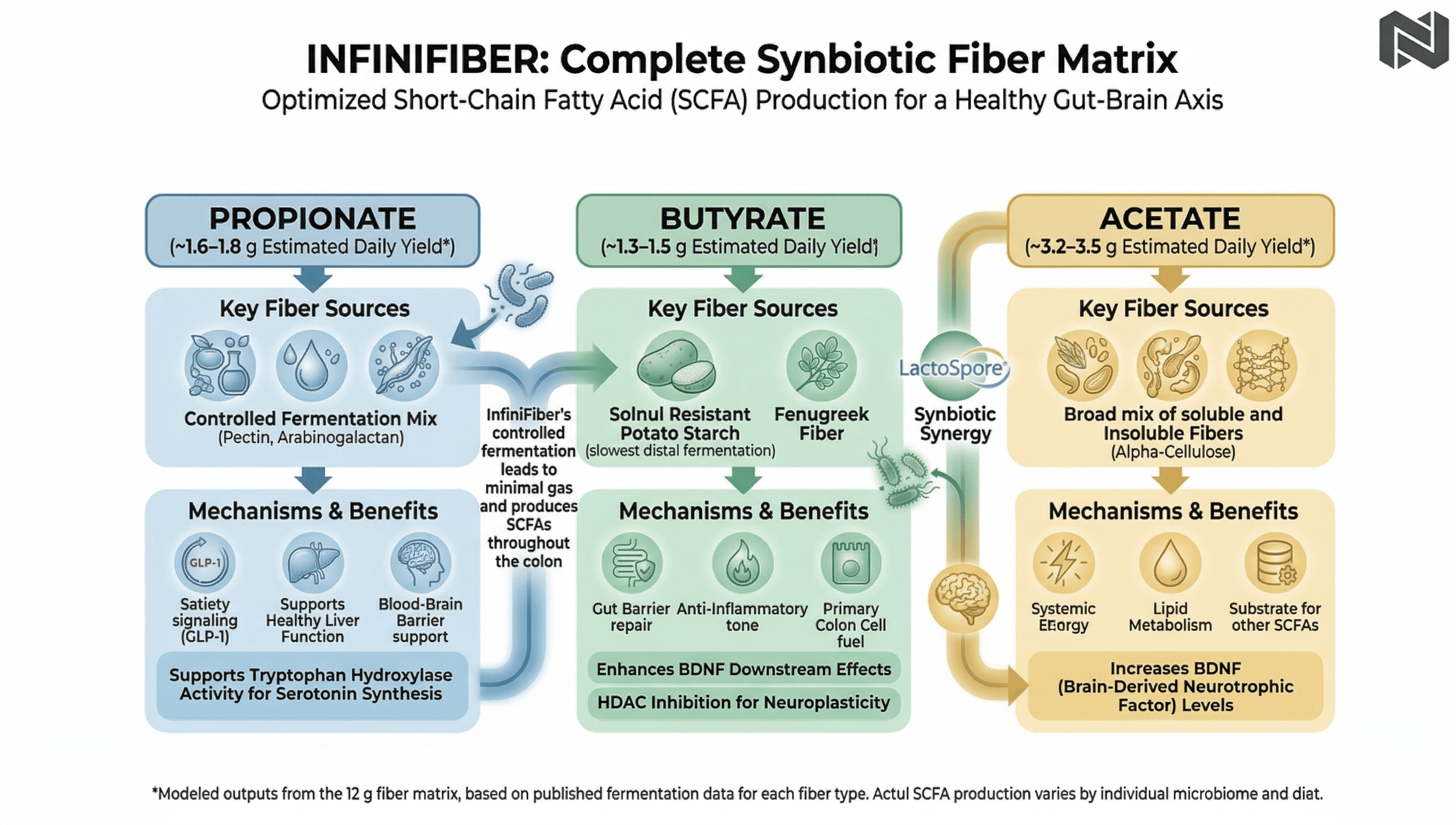
Now at this point, maybe you can start to see why we were getting so excited about fermentable fiber. All we had to do was provide the right precursors, and our microbiomes go right ahead and turn it into mood modulating nootropic compounds! Does it get any better? Not really, and this takes us back to an early doctrine of nootropics enthusiasts. Before getting into nootropics, it was always suggested to first optimize your overall health. That’s because your overall health has a huge impact on cognitive function. Due to this, it was very interesting to design a fiber supplement that helps enhance your baseline health, whilst also having the ability to formulate for nootropic purposes! This brings us to the actual formulation, which we’ll dive into now, because we were able to steer what SCFAs are being produced, and perhaps more importantly, when and where they were being produced in our gut.
When first approaching the formulation, it seemed like a brilliant idea to just ram as many highly fermentable fibers into the formulation, in order to produce the most amount of SCFAs possible. However, for anyone who has ever fermented kombucha, kefir or even beer, and had a little bit too much fermentable substrate in the mix, then you know just how explosive things can get! When we introduce a large amount of readily fermentable fibers to the microbiome, then our gut microflora is going to get to work on it right away. Throughout this process, it’s producing useful metabolites like SCFAs, but also a lot of CO2 gas, and other gasses like hydrogen. This CO2 gas is what makes a drink like kombucha fizzy during fermentation, but in our guts, it causes bubbling, bloating, and eventually comedically loud flatulence. Thus, providing lots of fast fermenting fiber, such as inulin, would cause a lot of GI discomfort and flatulence. This is why sunchokes, which are high in inulin, are often referred to as ‘fartichokes’!
In order to prevent excess gas production, we needed to do two things. First of all, we had to control the fermentation rate of all of the different fiber types. Not all fermentable fibers ferment at the same rate. Some fiber types ferment rapidly, which means that they ferment right as they hit our proximal colon, which can produce a large volume of gas. To understand this concept a little bit better, let's have a very quick rundown of what happens to food when we eat it. When we eat food, it is first broken down in our stomach, and digestion starts here via enzymes and hydrolysis. Then we end up with a substance called chyme which enters our small intestines. In our small intestines, more enzymes are introduced which breaks the chyme down further to release absorbable nutrients. At the end of the small intestines, most nutrition that we can utilize, has been pulled out of the chyme. What remains are the fibers and resistant starches. Or in other words, a big tasty meal for the microbes that live in our colon!
That brings us back to the proximal colon. This is the first section of our colon, and is where a fresh batch of small intestine processed chyme is deposited. This means it is absolutely chock full of fermentable fibers and resistant starches. Unsurprisingly, here in the proximal colon, is also where the highest concentration of microbes are. So, if you introduce a large amount of rapidly fermentable fiber into the proximal colon, our microbiome will rapidly ferment it which can produce a large volume of gas. This gas then travels upwards, and bends right into the mid colon. Here, more fermentation occurs, and further adds to the volume of gas. The gas keeps travelling along the mid colon, but is then suddenly faced with a challenge, it has to bend down! Gas doesn’t like to travel down, so in this right bend down into the distal colon, gas can become trapped and stretch this bend. You probably guessed it already, this is what causes bloating! Once the gas does get released and travels down the distal colon, then it turns into flatulence. So, this is why it is NOT a good idea to consume a large dose of a fast fermenting fiber like inulin, because it can easily lead to bloating and flatulence! Now, this might be a bit hard to visualise at first, so here is a handy graphic to help illustrate it:
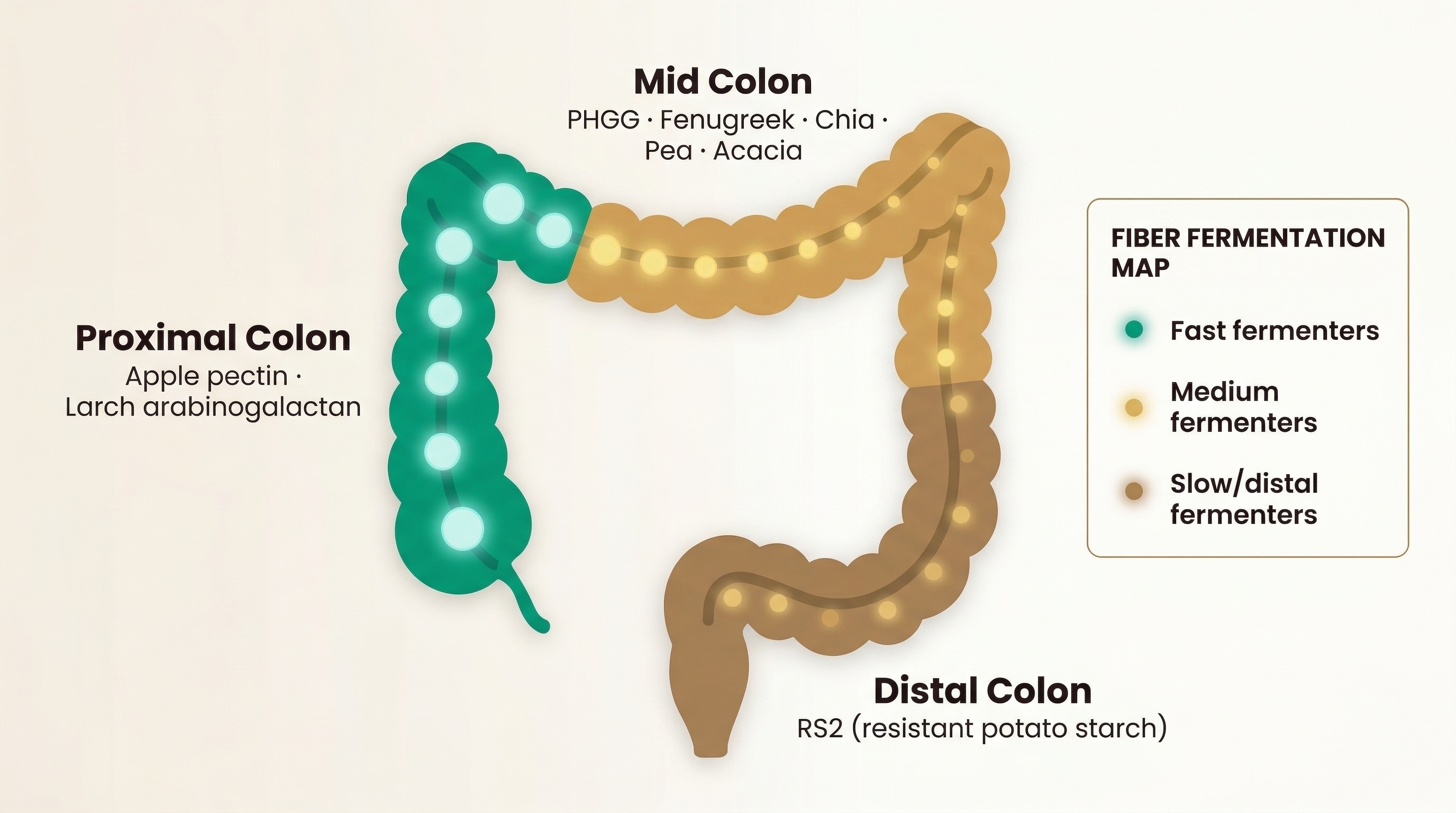
As you can see from the image above, we only have two fast fermenting fibers in Infinifiber, apple pectin (250 mg dose) and larch arabinogalactan (1,000 mg dose). Together, this is only 1.25 grams of fast fermenting fiber, which represent only 7.9% of the total formulation! To make things even better, there is one other additional descriptor for fiber types, and that is viscosity. Many fibers are non-viscous, meaning that they do not gel and thicken upon hydration. However, other fiber types, like apple pectin, fenugreek fiber and chia, are viscous. Viscous fibers have been shown to slow down the fermentation of fast fermenting fibers. Thus, by including three viscous fibers, we can further slow down gas production in the proximal colon. Another benefit of viscous fibers is that they encapsulate bile acid and prevent it from reabsorbing. This then forces our liver to produce more bile acids, which are conveniently made from cholesterol! Since that cholesterol is being turned into bile acids, it then reduces circulating levels of cholesterol. Viscous fibers also slow gastric emptying, and they expand in the stomach, which combined can increase satiety considerably!
Returning back to the image above, it has dots which represent the different fiber types categorized by speed. You can see that the dots for the fast fermenters are big and bright, but as you go along the colon, the dots get smaller and less bright. This is to represent where fermentation is most active. Clearly, the fermentation capacity in the proximal colon is super high, but it starts to slow in the mid colon. Unsurprisingly, you see a lot of the fibers in infinifiber being listed here. This is where the bulk of fermentation was designed to take place. We still have high microbial density here, so the processed chyme can easily be inoculated with lots of bacteria. More mechanical manipulation of the processed chyme occurs here too which mixes it up nicely, further incorporating microbes into it which can then get to work on fermenting the remaining fibers. Transit along the mid colon takes a while, and the fermentation of fibers slows here, so we are not nearly producing as much gas, as rapidly, as the proximal colon can do. This helps us keep down the gas production, whilst maximizing the production of SCFA.
As you can see on the image above, once you get to the distal colon, the dots get even smaller and less bright. This is because microbial fermentation slows to a crawl here. There is way less fermentable fiber left at this point, with only the slowest of fermenting fibers surviving the journey intact to the distal colon. With infinifiber, what makes it to the distal colon is primarily the slowest fermenting fiber of the bunch, Solnul resistant potato starch! It’s important to have fermentation and SCFA production still occurring in the distal colon, as many issues can arise in the distal colon due to the already lower levels of SCFA. This is why we wanted a large amount of slow fermenting fiber (3.5 grams of Solnul, the full clinical dose!) in Infinifiber, as most fiber supplements do not contain a sufficiently slow fermenting fiber type to allow SCFA production in the distal colon.
Is your head spinning yet? This is A LOT of information to consider! This is why it took us a long time to formulate Infinifiber! We took a lot of time to properly educate ourselves about the GI tract, microbial colonies, SCFAs, gas production etc. This allowed us to then develop a very intelligently designed formulation, that when we finally got to try it didn’t cause gas or bloating in any of us. This, despite the massive 12 gram dose of fiber! Many of us were mentally preparing ourselves for an onslaught of gas and bloating with such a large dose right off the bat, but none of us had issues. Goes to show how far you can push things, with good R&D!
Last but not least, we have to touch on Lactospore! This is what makes Infinifiber a synbiotic, which is defined as a combination of prebiotics + probiotics. The initial reason for adding Lactospore is because it helps reduce gas production. Can you tell yet, that we REALLY did not want this formula to produce gas? Lactospore does this via a variety of pathways, with one of the main pathways being producing lactic acid, which drops the pH of the GI tract, which then helps slow the activity of gas producing microbes. It also produces anti-microbial peptides that specifically target gas producing pathogenic bacteria. Lactospore has been clinically studied for its ability to reduce gas and bloating, so it was a great final layer of protection against the most common side effect associated with fiber supplementation.
Additionally, another reason why Lactospore was added is because it also helps produce SCFAs, primarily butyrate. Better yet, it appears to perfectly synergize with fenugreek fiber, which then produces significant amounts of butyrate. This was a unique synergy that we really wanted to include, since butryate is a major player in the benefits of prebiotic fibers.
Lastly, one of the most attractive things about Lactospore is that it is ridiculously stable! Studies have shown that you can even microwave it briefly without any degradation. Due to this stability, it makes it very easy to include in a powder formulation like Infinifiber. Additionally, not all probiotics survive harsh stomach acid, but Lactospore does, which also made it a great option to use in Infinifiber!
You probably already know by now, that we love to create stacks with our products. That’s definitely no different for Infinifiber, and we’ve already identified some really amazing combinations! When Infinifiber is combined with Infinigreens, we find that Infinigreens works even better. This is primarily noticed in stool structure. The one downside with Infinigreens is that if you do not consume enough bulking fiber like cellulose alongside it, it can make your stools overly soft. Infinifiber solves this, by providing lots of bulking fiber. Additionally, Infinigreens also does a great job at increasing satiety, and when combined with the satiety enhancing effects of Infinifiber, it can keep you full all day. This can be very handy if you are trying to minimize caloric intake!
We’ve also found Infinifiber to go really well with the Mushroom Magic powders. Those contain relatively large amounts of viscous fermentable beta-glucans. These stack very nicely with the fibers in Infinifiber. In fact, we considered adding some mushroom beta-glucans into infinifiber, but decided to forego it, envisioning instead that some of you would want to combine one of the Mushroom Magic products together with Infinifiber.